
The latest research has found that the pathogenesis of autoimmune diseases is also related to cytokines. Common targets for new therapeutic drugs, such as IL-6/17/23, GM-CSF, etc., are often involved. Globally, scientists have begun to use nanobodies to develop multiple different forms of therapeutic drugs for autoimmune diseases. For example, the global first nanobody drug Caplacizumab, developed and produced by Ablynx, a company acquired by Sanofi, and approved by the FDA in 2019, mainly treats acquired thrombotic thrombocytopenic purpura. This is a bivalent nanobody drug targeting the A1 domain of VWF, which can reduce platelet aggregation and microvascular thrombosis, and can lower the mortality and recurrence rates of the disease [1].。
Drug development targets and progress for autoimmune diseases [2]
|
名称 |
靶点 |
适应症 |
研发进度 |
文献 |
|
Caplaczumab |
VWF-A1 |
iTTP |
已上市 |
[3] |
|
M1095(ALX-0761) |
IL-17A/F |
Psoriasis |
临床Ⅱ期 |
[1,4] |
|
Vobarilizumab(ALX-0061) |
IL-6R |
RA,SLE |
临床Ⅱ期 |
[5] |
|
Ozoralizumab |
TNF-α |
RA |
临床Ⅲ期 |
[6-7] |
|
ATN-192 |
TNF-α |
SLE |
临床Ⅱ期 |
[8] |
|
ALX-0962 |
IgE |
Asthma |
临床前 |
[9] |
|
3Nb12 |
CXCL10 |
MS |
临床前 |
[10] |
Among the targets of interleukins, scientists have developed safe, stable and highly effective targeted treatment approaches.
Targeted IL-17/23 drug development is mainly used for the treatment of psoriasis. Researchers have found that IL-17 is associated with many autoimmune diseases, such as rheumatoid arthritis and multiple sclerosis. A nanobody drug M1095, which is currently in the second phase of clinical trials, has been modified to include an N-terminal part specific for IL-17F, a C-terminal part that binds IL-17A and IL-17F, and a central building block that binds to human serum albumin to prolong the plasma half-life [6, 10]. It achieves excellent performance in multiple clinical experiments by simultaneously targeting IL-17A/F to block the inflammatory response.
A targeted IL-6 bispecific nanobody drug called Vobarilizumab is used to treat rheumatoid arthritis. It consists of an anti-IL-6R domain and an anti-human serum albumin domain. This drug blocks the binding of IL-6R to the receptor and preferentially binds to sIL-6R to transduce its signaling pathway. Compared with previous drugs for treating rheumatoid arthritis, it has lower side effects.
Another drug for treating rheumatoid arthritis, Ozoralizumab, was also developed by Ablynx. It is a nanobody drug targeting TNF-α. After modification, it contains two anti-TNF-α domains and one anti-human serum albumin domain.
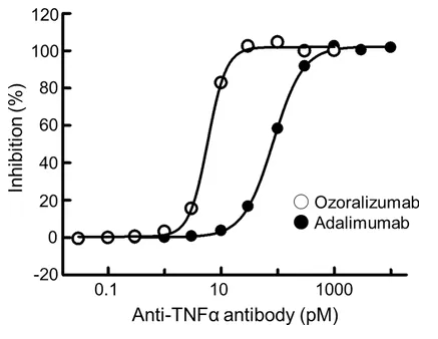
In the past, traditional drugs used to treat human rheumatoid arthritis, such as Adalimumab (a fully humanized monoclonal antibody against TNF-α), were employed. However, clinical studies revealed that this drug would lead to the formation of anti-drug antibodies (ADAs) during long-term administration. As the formation of ADAs accelerated and the clearance process of the biological agent was too slow, the therapeutic effect gradually diminished [11]. However, Ozoralizumab demonstrated an extremely high affinity for human TNF-α in clinical trials, and no obvious formation of ADAs or serious adverse reactions occurred during long-term administration. Currently, this drug is undergoing clinical Phase III trials.
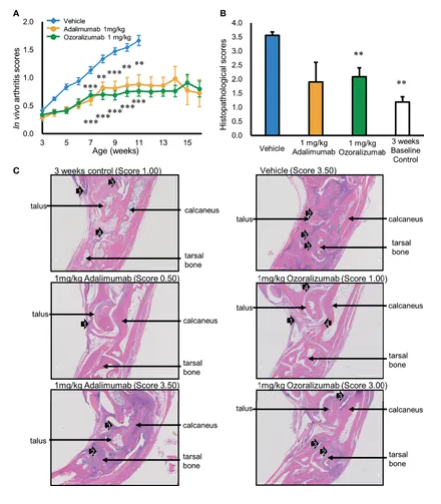
In conclusion, due to the characteristics of nanobodies such as ease of modification and strong penetration ability, they demonstrate advantages in drug development and clinical trials that are far more safe and stable than traditional antibody drugs. Moreover, the modified nanobody drugs have greater potential in targeting capabilities for treating various autoimmune diseases, such as targeting IL6/17/23, etc. Nanobodies can not only simultaneously bind to IL-17A/F, but also selectively inhibit pathogenic factors. Nanobodies may become one of the most promising strategies for developing drugs for autoimmune diseases.
参考文献:
[1] JOLY B S,COPPO P,VEYRADIER A. An update on pathogenesis and diagnosis of thrombotic thrombocytopenic purpura[J]. Expert Rev Hematol,2019,12(6):383-395. DOI:10.
[2] 敖正宏,王玥,梅雅贤,等.纳米抗体在自身免疫性疾病中的应用[J].中国免疫学杂志,2024,40(01):178-184.
[3] MAZEPA M A,MASIAS C,CHATURVEDI S. How targeted therapy disrupts the treatment paradigm for acquired TTP:The risks,benefits,and unknowns[J]. Blood,2019,134(5):415-420. DOI:10. 1182/blood. 2019000954.
[4] SUKUMAR S, LAMMLE B, CATALAND S R. Thrombotic thrombocytopenic purpura:Pathophysiology,diagnosis, and management[J]. J Clin Med, 2021,10(3):536. DOI:10. 3390/jcm10030536.
[5] HANLON A, METJIAN A. Caplacizumab in adult patients with acquired thrombotic thrombocytopenic purpura[J]. Ther Adv Hematol,DOI:10. 1177/204062 0720902904.
[6] TORRES T,ROMANELLI M,CHIRICOZZI A. A revolutionary therapeutic approach for psoriasis:Bispecific biological agents[J]. Expert Opin Investig Drugs,2016,25(7):751-754. DOI:10. 1080/13543784. 2016. 1187130.
[7] GREB J E, GOLDMINZ A M, ELDER J T,et al. Psoriasis[J].Nat Rev Dis Primers,2016,2:16082. DOI:10. 1038/nrdp. 2016. 82.
[8] FERNANDES J C. Therapeutic application of antibody fragments in autoimmune diseases:Current state and prospects[J].Drug Discov Today, 2018, 23(12):1996-2002. DOI:10. 1016/j. drudis. 2018. 06. 003.
[9] BOUTET M A, NERVIANI A, GALLO AFFLITTO G,et al. Role of the IL-23/IL-17 axis in psoriasis and psoriatic arthritis:The clinical importance of its divergence in skin and joints[J].Int J Mol Sci,2018,19(2):530. DOI:10. 3390/ijms19020530.
[10] PAPP K A,WEINBERG M A, MORRIS A,et al. IL17A/F nanobody sonelokimab in patients with plaque psoriasis:A multicentre, randomised,placebo-controlled, phase 2b study[J].Lancet,2021,397(10284):1564-1575. DOI:10. 1016/S0140-6736(21)00440-2.
[11] Rubbert-Roth A, Szabó MZ, Kedves M, Nagy G, Atzeni F, Sarzi-Puttini P. Failure of Anti-TNF Treatment in Patients With Rheumatoid Arthritis: The Pros and Cons of the Early Use of Alternative Biological Agents. Autoimmun Rev (2019) 18(12):102398. doi: 10.1016/j.autrev.2019.102398