
Soluble Protein Immunization:
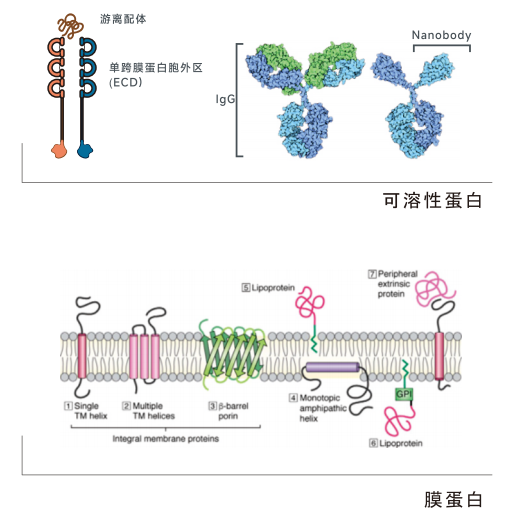
This immunization strategy targets soluble antigens such as free ligands and extracellular domains (ECDs) of single-pass transmembrane proteins. These antigens feature stable spatial conformations and straightforward preparation and quality control workflows. They can effectively stimulate animals’ immune systems to trigger target-specific immune responses, enabling subsequent screening of full-length IgG antibodies or smaller nanobodies with superior tissue penetration. It serves as a universal solution for developing research-grade and diagnostic antibodies.
Membrane Protein Immunization:
Membrane proteins adopt intricate architectures including single-pass transmembrane helices, multi-pass transmembrane helices, β-barrel pore proteins, monotopic amphipathic helices, lipoproteins and peripheral membrane proteins. Naturally embedded within phospholipid bilayers, their hydrophobic transmembrane segments are prone to denaturation, and standard recombinant protein production struggles to fully preserve native conformations.
Nabo Life has developed proprietary immunization workflows tailored to integral membrane proteins, peripheral membrane proteins and lipoproteins. Our protocols maximize retention of the complete native 3D structure of membrane proteins and fully expose authentic epitopes on extracellular and transmembrane domains. This effectively avoids failed immunization and enrichment of low-specificity clones caused by antigen denaturation, facilitating the screening of functional nanobodies against membrane protein targets. The technology supports antibody discovery for challenging druggable targets including GPCRs, ion channels and viral envelope proteins.
Protein antigens are adopted for immunization based on target analysis. The immunization procedure and timeline are shown below:
| No. | Time |
Immunization Procedure |
| 1 | Day 0 |
Collect 10 mL of whole blood as reserved negative serum. |
| 2 |
Day 1 |
1st: 0.5 mg protein immunogen + Complete Freund's Adjuvant (CFA); Subcutaneous injection at 10 sites. |
| 3 |
Day 14 |
2nd: 0.25 mg protein immunogen + Incomplete Freund's Adjuvant (IFA); Subcutaneous injection at 5 sites. |
| 4 |
Day 21 |
Collect 1 mL of whole blood, separate serum, and perform protein ELISA titer testing. |
| 5 |
Day 28 |
3rd: 0.25 mg protein immunogen + Incomplete Freund's Adjuvant (IFA); Subcutaneous injection at 5 sites. |
| 6 |
Day 35 |
Collect 1 mL of whole blood, separate serum, and perform protein ELISA titer testing. |
| 7 |
Day 42 |
4th: 0.25 mg protein immunogen + Incomplete Freund's Adjuvant (IFA); Subcutaneous injection at 5 sites. |
| 8 |
Day 49 |
Collect 10 mL of whole blood, separate serum, and perform ELISA titer testing. Based on titer results:
|
Result Analysis:
Deliverables: