
Mammalian cell display technology differs from other display technologies such as phage display and yeast display. It is an advanced platform engineered to optimize the druggability of therapeutic antibodies. This technology can not only be applied to antibody engineering represented by affinity maturation and humanization, but also be used for monoclonal antibody screening with superior sequence specificity.
During the development of antibody therapeutics, conventional display technologies impose severe constraints on antibody formats. As a result, antibody screening for both antibody discovery and antibody engineering is mostly performed in scFv or Fab formats. When reformatted into structures suitable for downstream applications, antibodies often suffer from shifts in affinity and physicochemical properties.
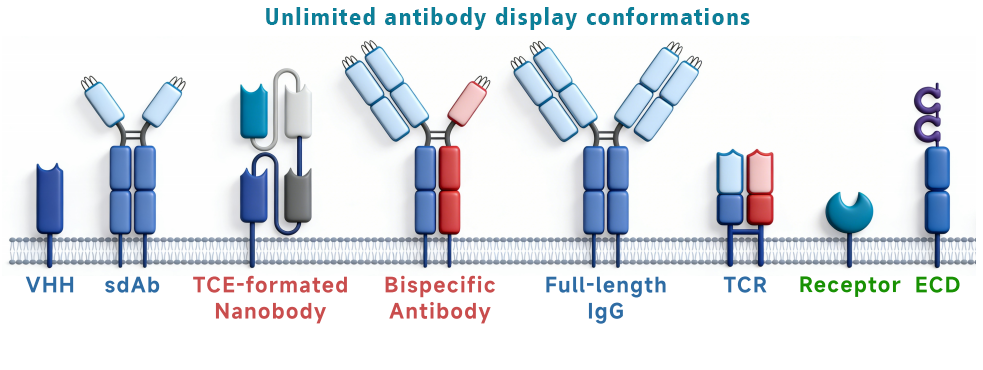
Powered by mammalian cell display technology, NabLib® and AbEngin® platforms support the display of diverse antibody formats as illustrated below. For instance, nanobodies can be directly screened in VHH, single heavy chain, bispecific antibody, CAR, and even TCE formats without reformatting, enabling seamless compatibility with downstream applications. Full-length IgG derived from mouse, rabbit and human can also be displayed in their native forms. Meanwhile, TCRs are available for display in their natural conformation as well as various Fc-fusion formats.
This design enables seamless integration between antibody screening and downstream functional assays, significantly accelerating the R&D progress of antibody drugs and targeted therapeutics.
Affinity maturation:
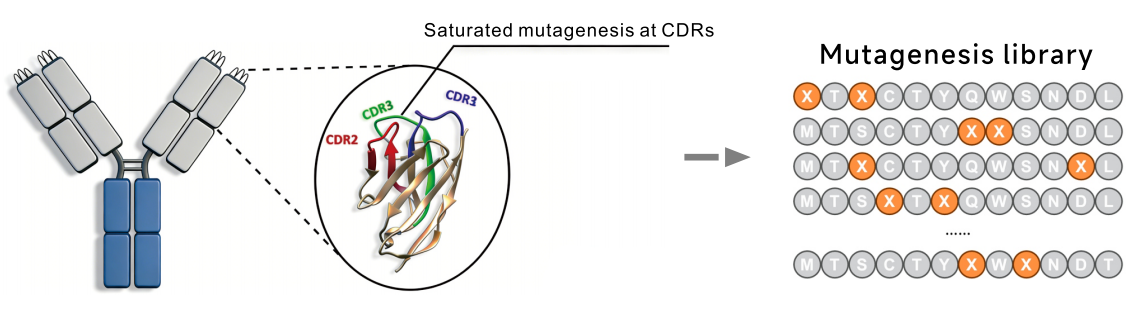
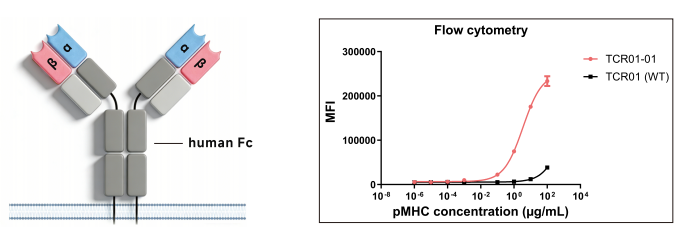
The AbEngin® Antibody Engineering Platform delivers experiment-based affinity maturation screening services. Beyond conventional phage display technology, the platform leverages mammalian cell display technology to optimize the affinity of various antibody formats.For instance, murine and rabbit antibodies can be directly displayed and screened in full-length IgG conformation, while TCR molecules are screened via Fc-fusion expression constructs.
Technical Advantages:
|
|
||
 |
 |
 |
|
Mammalian cell display is a powerful antibody screening tool, which can effectively balance the library capacity and sequence specificity, and ensure the physicochemical properties of antibodies, thereby improving their pharmacability. |
The mammalian display technology can not only be applied in the process of antibody screening, but also play a significant role in antibody engineering. It can be well adapted to humanization (or canine/feline source modification), affinity maturation, and PTM optimization, while maintaining excellent physicochemical properties. |
Mammalian cell display technology is not only applicable to scFv or Fab-based antibodies, but also can efficiently display complex antibody structures such as full-length IgG, VHH, and TCR. It can even directly be used in the screening of antibodies in the form of bispecific antibodies, completing the one-step construction of bispecific antibodies and affinity adjustment in a seamless manner. |
Screening of the full-spectrum configuration:
Mammalian cell display technology VS Other display technologies:


Representative cases 1:Affinity maturation
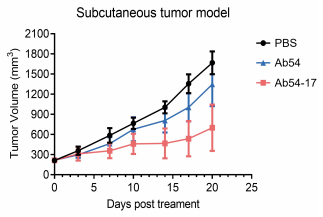
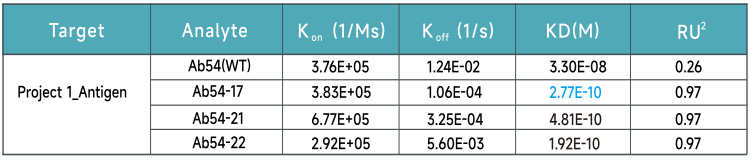
A single mutation in CDR3 results in significant affinity improvement.
|
SPR |
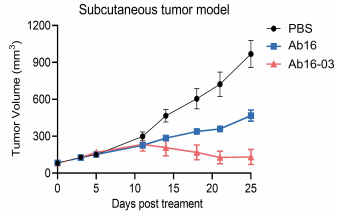
Mouse In Vivo Efficacy |
|
|
 |
Representative cases 2 : Species-Specific Affinity Screening
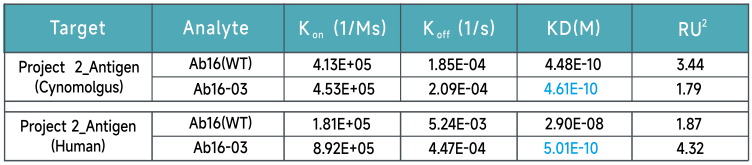
The mutant enhances affinity for human antigen while retaining binding affinity to cynomolgus monkey antigen.Mouse In Vivo Efficac.
| SPR |
Mouse In Vivo Efficacy |
|
|
 |
Representative cases 3:TCR Affinity Maturation
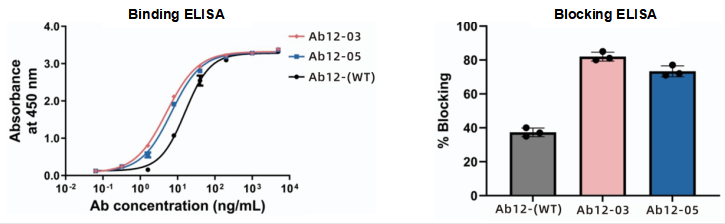
Representative cases 4:Small Molecule Antibody Affinity Maturation
|
Small Molecule Antibody Affinity MaturationImprovement of the affinity and neutralizing activity of anti-small molecule antibody |
 |