

In August 2026, nanobody-based autoimmune therapeutics reached a key milestone. MoonLake Immunotherapeutics announced the full Phase III results of IZAR-1, the pivotal trial of its lead candidate Sonelokimab (M1095) in psoriatic arthritis (PsA): all primary and key secondary endpoints were met, with a favorable safety signal. As a trivalent, humanized nanobody targeting IL-17A/F, the drug leverages a differentiated molecular architecture to overcome the clinical limitations of conventional monoclonal antibodies, offering a new technological paradigm for innovative drug development in rheumatic and autoimmune diseases.
1. Disease Mechanism and Pain Points of Conventional Drug Development
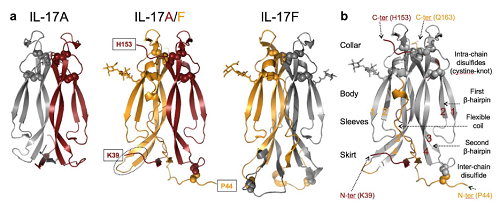
Simultaneous display of IL-17A/A (left, 4HR9), IL-17A/F heterodimer (center), and IL-17F/F (right, 1JPY) ribbon models, with disulfide bonds and glycosylation sites annotated. Source: Sci Rep. 2017;7:8360 (PMC5566378), “The human IL-17A/F heterodimer: a two-faced cytokine with unique receptor recognition properties.”
Psoriatic arthritis is a chronic autoimmune disease driven by systemic inflammation, with high rates of disability and relapse. The IL-17 family constitutes the core pathway driving disease onset and progression: IL-17A and IL-17F can form three active dimeric species—A/A, A/F, and F/F—which collectively mediate synovial hyperplasia, joint damage, cutaneous lesions, and entheseal inflammation.
Most IL-17 inhibitors currently used in clinical practice are conventional full-size IgG monoclonal antibodies with notable technical limitations. First, they specifically target IL-17A only and fail to block IL-17F-mediated inflammatory pathways; clinically, approximately 30%–40% of patients do not achieve minimal disease activity (MDA), reflecting limited treatment response. Second, conventional IgGs have a molecular weight of approximately 150 kDa; their large size results in poor penetration into deep inflamed tissues with sparse vasculature, such as the synovium and entheses, leading to insufficient drug exposure at the lesion site and compromising overall efficacy. Third, the production of full-length antibodies is technically complex, and the short dosing intervals compromise patient adherence.
2. Core Structural Advantages of the Sonelokimab Nanobody
Sonelokimab is a trivalent tandem humanized VHH molecule engineered on modular nanobody technology. With a molecular weight of only approximately 40 kDa and no Fc domain, it is fundamentally distinct from conventional monoclonal antibodies. The molecule comprises three functionally independent VHH domains assembled in tandem via flexible GS linkers: two specific VHHs precisely bind IL-17A and IL-17F, respectively, enabling complete neutralization of all three active IL-17 dimeric species and full-pathway inhibition; the third VHH domain binds human serum albumin (HSA).
This unique architecture delivers multiple technological breakthroughs. HSA binding markedly extends the in vivo half-life, enabling long-interval subcutaneous dosing every 4 weeks. The molecule also specifically accumulates in inflamed and edematous tissues, substantially increasing local drug concentration and tissue-penetration efficiency at the lesion site. The absence of an Fc domain avoids non-specific effector activation and immune interference, resulting in a superior overall safety profile.
3. Key Clinical Evidence (Phase II/III)
Data from the Phase II ARGO trial, published in Nature Medicine in 2025, initially validated the drug’s excellent efficacy and safety. In the 60 mg induction group, the ACR50 response rate reached 46.3% at week 12, and PASI90 skin clearance rates ranged from 59% to 77%. At the 24-week follow-up, 61% of subjects achieved minimal disease activity (MDA), and the ACR70+PASI100 composite endpoint response rate reached 48%, demonstrating significantly superior efficacy to the active comparator adalimumab. The drug was also well tolerated, with a candidiasis incidence of only 2% and no serious adverse events, laying a solid foundation for advancement into Phase III.
Full data from the Phase III IZAR-1 trial, unveiled in August 2026, show that in biologic-naïve patients with active psoriatic arthritis, the drug achieved a 42.1% ACR50 response rate—the primary endpoint—at week 16. Key secondary endpoints included an ACR20 response of 66.5%, an MDA achievement rate of 41.2%, and a PASI90 skin clearance rate of 61%. In addition, patient-reported outcomes such as the HAQ-DI physical function score and the SF-36 quality-of-life score showed statistically significant improvements, with no new safety signals. The clinical benefit is clear.
4. Multi-Indication Expansion and Market Prospects
Sonelokimab now has a multi-indication pipeline spanning two core therapeutic areas: dermatology and rheumatology. Long-term 52-week data from its Phase III trial in hidradenitis suppurativa showed HiSCR75 response rates of 62%–68%, with complete clearance (HiSCR100) in approximately 30% of patients, indicating durable efficacy. In a Phase II trial in axial spondyloarthritis, the drug significantly improved sacroiliac joint inflammation, achieving radiographic-level benefit. In addition, the indication of palmoplantar pustulosis has been granted FDA Fast Track designation, opening broad market potential.
From an industry perspective, the clinical success of Sonelokimab validates the core advantages of modular multivalent nanobodies in autoimmune diseases: small molecular size, strong tissue penetration, flexible target assembly, and long-acting, low-toxicity druggability. These properties break the technical bottlenecks of conventional monoclonal antibodies and establish nanobodies as a new direction for autoimmune drug discovery.
5. Our Capabilities
Our company provides comprehensive end-to-end nanobody CRO services, offering integrated solutions spanning target-specific nanobody screening, humanization, multivalent tandem molecule construction, affinity optimization, in vitro activity validation, and cell-based efficacy evaluation. Supported by standardized platforms including BLI-based affinity measurement, FACS-based cell binding validation, and cytokine inhibition activity assays, we can rapidly deliver highly stable, highly specific VHH candidate molecules, helping pharmaceutical companies and research teams accelerate the development and translation of innovative antibody pipelines in autoimmune diseases, oncology, and beyond.> Our company is deeply committed to end-to-end nanobody discovery services, with extensive experience in antibody development across autoimmune-related targets. Leveraging two technology platforms—phage display and mammalian cell display—we are able to screen nanobody molecules with biological functionality. Beyond broad-spectrum antibody development for autoimmune targets, we also have proven expertise in antibody screening against inflammatory cytokines:
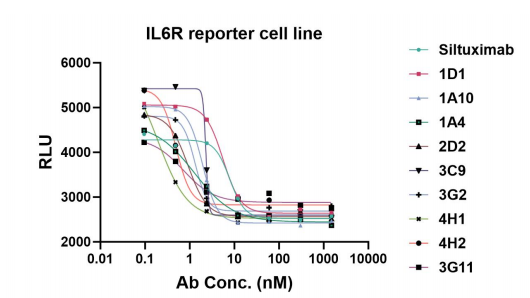
IL6 Nb development by mammalian cell display
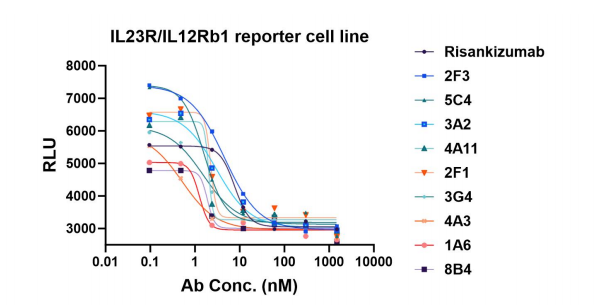
IL23p19 Nb development by pDual-phage display
Nanobody Full-Spectrum Customized Services byNBLST
NBLST is a nanobody industry platform initiated and established by Wuhan Industrial Innovation and Development Institute. It owns an independent laboratory covering 1,400 square meters at the Precision Medicine Industrial Base of Wuhan National Bioindustry Base. Meanwhile, it has set up an alpaca experimental base and a transit base compliant with laboratory animal standards in Zuoling, Wuhan and Tuanfeng, Huanggang respectively. At present, the bases house more than 200 alpacas in total, and can provide alpaca immunization services with "zero immune background" guarantee for research institutions and antibody drug R&D enterprises.
NBLST focuses on the research, development, engineering and application of nanobodies, and is committed to building an integrated industry-university-research public experimental service platform. The company has established a full-chain technology platform covering antigen preparation (polypeptides, proteins and RNA), antibody discovery and engineering modification, as well as biological function validation and screening. Among these, its RNA antigens include sequence- and structure-optimized RNA products suitable for alpaca immunization.Based on the proprietary NabLib® platform, the company employs the improved pDual bifunctional phage display technology. While retaining the high-efficiency development advantages of traditional phage display, this technology enables seamless connection with high-level expression in mammalian cells, significantly improving the efficiency of eliminating problematic molecules. Its NabLib® mammalian cell display technology not only enhances the developability of antibody molecules, but also allows flexible selection of screening formats, providing reliable support for downstream antibody applications and detection.Through the synergistic complementation of multiple platforms, the company provides flexible and efficient antibody discovery and engineering services for pharmaceutical companies and research institutions, supporting the development of innovative drugs and diagnostic reagents.
Contact Us:
Tel: 400-822-9180
Email: marketingdept@nanobodylife.com
References
[1] McInnes IB, et al. Sonelokimab, an IL-17A/IL-17F-inhibiting nanobody for active psoriatic arthritis: a randomized, placebo-controlled phase 2 trial. Nature Medicine, 2025, 31(10): 1842–1851. DOI: 10.1038/s41591-025-03971-6.
[2] MoonLake Immunotherapeutics. MoonLake Announces Positive Topline Results from the Phase 3 IZAR-1 Trial of Sonelokimab in Psoriatic Arthritis [EB/OL]. 2026-08-10.
[3] Vanheusden K, et al. Pre-clinical proof-of-concept of ALX-0761, a Nanobody neutralizing both IL-17A and F in a cynomolgus monkey collagen induced arthritis model. Arthritis & Rheumatology, 2014, 66: S111–S111.
[4] Svecova D, et al. Sonelokimab down-regulates cutaneous inflammatory gene signatures in moderate-to-severe plaque psoriasis. Journal of the American Academy of Dermatology, 2019, 81(2): 196–203.