

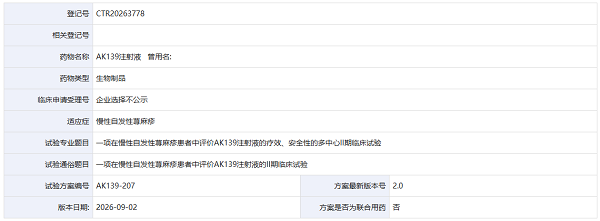
The type 2 inflammation antibody field has recently gained fresh momentum. On 8 October 2026, Akeso's Class 1 innovative drug AK139 injection posted Phase II clinical trial information for chronic spontaneous urticaria (registration no. CTR20263778). As the world's first IL-4Rα/ST2 bispecific antibody, AK139 has completed its Phase I study and has launched seven Phase II trials in parallel, covering asthma, atopic dermatitis, chronic rhinosinusitis with nasal polyps, chronic spontaneous urticaria, allergic rhinitis, COPD and other type 2 inflammation-related diseases, offering a valuable reference for the development of new drugs against mixed allergic inflammation.
IL-4Rα and ST2 are the core upstream and downstream targets that govern type 2 inflammation. IL-4Rα is the receptor subunit shared by IL-4 and IL-13; its activation drives Th2 immune responses and mediates eosinophil infiltration, skin barrier damage and airway remodelling, and antibodies directed against this target are already used clinically. ST2 is the specific receptor for the alarmin IL-33: once IL-33 released from damaged tissue binds ST2, it initiates early inflammatory signalling, amplifies Th2 responses and activates a subset of non-Th2 immune cells. No ST2-targeted drug has yet been approved in China.In pathway terms, IL-33/ST2 drives the initiation and amplification of inflammation, whereas IL-4/IL-13/IL-4Rα sustains its chronic progression. An IL-4Rα antibody alone blocks only the downstream effector arm and cannot intervene in IL-33-mediated early inflammation, so clinical benefit remains limited in some patients with mixed inflammation. AK139 was designed on exactly this rationale, inhibiting both targets simultaneously; Phase I data indicate a favourable safety profile, and half-life optimisation should improve adherence in patients on long-term therapy.
Nanobodies (VHH single-domain antibodies) have a molecular weight of approximately 15 kDa, one-tenth that of conventional IgG, which gives them distinctive advantages in constructing IL-4Rα/ST2 bispecific molecules. IL-4Rα and ST2 are membrane receptors whose ligand-binding pockets are mostly grooves and cryptic epitopes, so conventional IgG molecules are too sterically hindered to engage them efficiently. Nanobodies, with their longer CDR3 loops, can reach deep into protein clefts and competitively block ligand–receptor interactions.The modular architecture of nanobodies allows different VHH domains to be joined directly through linkers to build bispecific molecules, circumventing the heavy/light chain mispairing and chain exchange that complicate conventional IgG-based bispecifics and thereby easing process development. Nanobodies also show excellent physicochemical stability, making them compatible with nebulised and intranasal formulations for local delivery to the respiratory tract, which enriches the drug at the site of disease while limiting systemic exposure; prokaryotic expression systems further increase yield and keep manufacturing costs under control. Preclinical animal studies have confirmed that IL-4Rα-targeting nanobodies effectively suppress airway Th2 inflammation. Once humanised, they carry a low risk of immunogenicity, making them well suited to chronic diseases such as urticaria and atopic dermatitis that require repeated long-term dosing, while reducing the likelihood of anti-drug antibody formation.
Our company offers end-to-end nanobody CRO services, providing an integrated solution that spans target-specific nanobody screening, humanisation, multivalent tandem molecule construction, affinity maturation, in vitro activity validation and cell-based potency assessment. Backed by standardised platforms for BLI affinity measurement, FACS cell-binding assays and cytokine inhibition assays, we rapidly deliver highly stable, highly specific VHH candidates, helping pharmaceutical companies and research teams accelerate the development and translation of innovative antibody pipelines in autoimmune disease, oncology and beyond.

NBLST focuses on the research, development, engineering and application of nanobodies, and is committed to building an integrated industry-university-research public experimental service platform. The company has established a full-chain technology platform covering antigen preparation (polypeptides, proteins and RNA), antibody discovery and engineering modification, as well as biological function validation and screening. Among these, its RNA antigens include sequence- and structure-optimized RNA products suitable for alpaca immunization.Based on the proprietary NabLib® platform, the company employs the improved pDual bifunctional phage display technology. While retaining the high-efficiency development advantages of traditional phage display, this technology enables seamless connection with high-level expression in mammalian cells, significantly improving the efficiency of eliminating problematic molecules. Its NabLib® mammalian cell display technology not only enhances the developability of antibody molecules, but also allows flexible selection of screening formats, providing reliable support for downstream antibody applications and detection.Through the synergistic complementation of multiple platforms, the company provides flexible and efficient antibody discovery and engineering services for pharmaceutical companies and research institutions, supporting the development of innovative drugs and diagnostic reagents.
Contact Us:
Tel: 400-822-9180
Email: marketingdept@nanobodylife.com
References
[1] National Medical Products Administration, Drug Clinical Trial Registration and Information Disclosure Platform. CTR20263778, Phase II clinical trial of AK139 injection [EB/OL]. 2026-10-08
[2] Le Flocʼh A, Allinne J, Nagashima K, et al. Dual blockade of IL-4 and IL13 with dupilumab, an IL-4Rα antibody, is required to broadly inhibit type 2 inflammation[J]. Allergy, 2020,75:1188-1204 .
[3] Cayrol C, Girard J P. IL-33: an alarmin cytokine with critical roles in innate immunity, inflammation and allergy[J]. Nature Reviews Immunology,2014,14(12):797-808.
[4] Yu Y, et al. Research Progress and Applications of Multivalent, Multispecific and Modified Nanobodies for Disease Treatment[J]. Frontiers in Immunology,2021,12:838082.
[5] Zhang S, Yao Z R. Research advances in type 2 inflammation pathways and biologics for atopic dermatitis [J]. Chinese Journal of Dermatology, 2024, 57(03): 278-282.
[6] Li X, et al. Advances in nanobody multimerization and multispecificity: from in vivo assembly to in vitro production [J]. Frontiers in Immunology,2024,15:1287642.
[7] Preclinical study of LQ036: A novel inhalable nanobody targeting IL-4Rα for the treatment of asthma [R]. Internal research report, Novamab, 2025.