
Recently, a major breakthrough has been announced in the biopharmaceutical industry: SIM0613, an innovative LRRC15-targeted antibody-drug conjugate (ADC) developed by Simcere Zaiming, has been officially approved for clinical trials. With outstanding preclinical data, this drug has secured an international licensing collaboration worth over RMB 1.06 billion, once again bringing the promising niche target LRRC15 into the industry spotlight. As competition in the solid tumor targeted therapy arena intensifies, urgent breakthroughs are needed to address key challenges including drug resistance, off-target effects, and toxic side effects. Featuring high tumor-specific expression, LRRC15 has emerged as a premier target for the development of ADCs and antibody-based therapeutics.
In-Depth Analysis: Structure and Core Biological Functions of the LRRC15 Target
Structure
LRRC15 (Leucine-Rich Repeat Containing 15) is a highly druggable type I transmembrane protein located at chromosome 3q29. Comprising 581 amino acids, it belongs to the LRR superfamily and lacks an intracellular signaling domain[1]. Its well-defined molecular structure is ideally suited for targeted drug development. The extracellular domain serves as the core functional region, containing a conserved N-terminal LRR domain and 15 canonical leucine-rich repeats that form a distinctive horseshoe-shaped scaffold, enabling precise protein-protein interactions as the critical binding site for targeted agents. A short transmembrane domain anchors the protein to the cell membrane, while the intracellular domain participates in the regulation of cellular signaling[2].
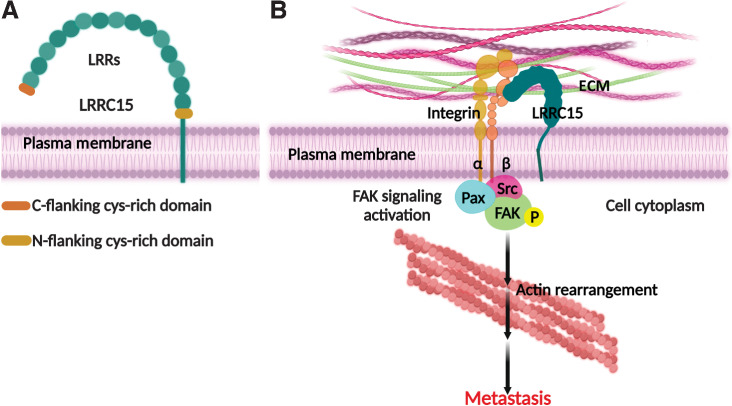
Figure 1 Structural diagram of LRRC15 (A) and its role in promoting cancer metastasis via activation of focal adhesion kinase signaling (B)[1]
Expression Profile and Regulatory Mechanism
Highly specific expression represents the key advantage of this target. LRRC15 is expressed at extremely low levels in normal human tissues, with minimal presence only in the lung, placenta, and a few other organs. In contrast, it is aberrantly overexpressed in various malignant solid tumors (such as sarcomas and glioblastomas) as well as in cancer-associated fibroblasts (CAFs)[3]. Furthermore, LRRC15 modulates the tumor microenvironment, mediates immunosuppression, and can bind to the SARS-CoV-2 spike protein to block viral entry, offering dual potential in oncology and antiviral drug development. It is thus a high-quality target combining innovation and practical utility.

Figure 2 LRRC15+ CAFs promote tumor immune escape by secreting chemokines[2]
Drug Design: Structural Rationale of SIM0613 ADC
SIM0613, the clinically approved candidate, is a typical innovative LRRC15-targeted ADC designed to balance targeting precision and antitumor activity. Built on the classic three-component ADC architecture, it employs established conjugation technologies to precisely link an LRRC15-specific antibody, a cleavable linker, and a potent cytotoxic payload. The drug selectively targets LRRC15 antigens on the surface of tumor cells and CAFs, enters cells via endocytosis upon binding, and releases the cytotoxic payload to kill target cells. Preclinical data demonstrate that SIM0613 achieves complete tumor regression at low doses and retains potent antitumor activity in LRRC15 low-expression tumor models, with excellent safety and efficacy profiles.
Global Pipeline Review: LRRC15 Field Expands Rapidly, Nanobodies Become a New Frontier
The global LRRC15 drug development pipeline is expanding rapidly, with 16 ongoing programs spanning ADCs, monoclonal antibodies, bispecific antibodies, CAR-T cell therapy, and other modalities, most focused on overcoming solid tumor drug resistance.Among overseas pipelines, ADC candidates including SOT106 and ABBV-085 are in clinical development, validating the druggability of this target. ABBV-085, an ADC originated by AbbVie in 2015, has no recent updates but its preclinical data confirm LRRC15’s feasibility as a solid tumor therapeutic target[3].In China, in addition to Simcere Zaiming’s SIM0613, Zai Lab’s ADC ZL-6201 has also received clinical approval. Several other companies have monoclonal antibody and bispecific antibody programs in the preclinical stage.
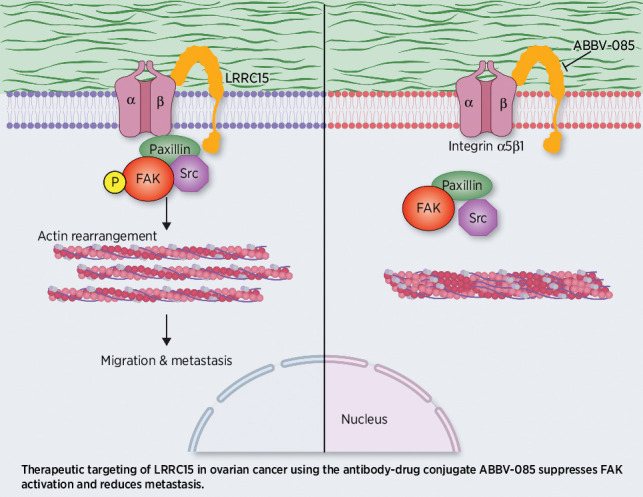
Figure 3 The LRRC15targeted ADC ABBV085 suppresses FAK activation and reduces metastasis in preclinical ovarian cancer models[1]
Advantages of Nanobodies in Addressing Challenges in Solid Tumor Targeting
Compared with conventional full-length antibodies, nanobodies offer inherent structural advantages and have become an emerging direction for LRRC15-targeted drug development. Traditional IgG antibodies suffer from large molecular size and poor tissue penetration, struggling to infiltrate the dense stroma of solid tumors. In contrast, nanobodies retain only the heavy-chain variable domain, featuring ultra-small molecular weight, strong tissue penetration, and deep solid tumor infiltration. They also exhibit low immunogenicity, high stability, ease of engineering and modification, and low production costs[4], perfectly matching the requirements of LRRC15-targeted therapy in the tumor microenvironment and filling technical gaps of conventional agents. Global LRRC15 nanobody pipelines are continuously expanding, mainly applied in ADC and immunoconjugate development, with strong commercial potential.
References
[1] Ray U, Jung DB, Jin L, Xiao Y, Dasari S, Sarkar Bhattacharya S, Thirusangu P, Staub JK, Roy D, Roy B, Weroha SJ, Hou X, Purcell JW, BakkumGamez JN, Kaufmann SH, Kannan N, Mitra AK, Shridhar V. Targeting LRRC15 Inhibits Metastatic Dissemination of Ovarian Cancer.Cancer Res. 2022 Mar 15;82(6):10381054.
[2] Zhu J, Xiao J. LRRC15 in tumorigenesis, progression, and therapy.Cancer Treat Res Commun. 2026;46:101110. doi: 10.1016/j.ctarc.2026.101110. Epub 2026 Jan 16. PMID: 41576525.
[3] Purcell JW, Tanlimco SG, Hickson J, Fox M, Sho M, Durkin L, et al. LRRC15 is a novel mesenchymal protein and stromal target for antibodydrug conjugates.Cancer Res 2018;78:4059–4072.
[4] Hurley K, Cao M, Huang H, Wang Y. Targeted Alpha Therapy (TAT) with SingleDomain Antibodies (Nanobodies).Cancers (Basel). 2023 Jul 4;15(13):3493. doi: 10.3390/cancers15133493. PMID: 37444603; PMCID: PMC10340719.
Wuhan Nanobody Life: Building a Leading Nanobody R&D Platform
NBLST is a nanobody industry platform initiated and established by Wuhan Industrial Innovation and Development Institute. It owns an independent laboratory covering 1,400 square meters at the Precision Medicine Industrial Base of Wuhan National Bioindustry Base. Meanwhile, it has set up an alpaca experimental base and a transit base compliant with laboratory animal standards in Zuoling, Wuhan and Tuanfeng, Huanggang respectively. At present, the bases house more than 200 alpacas in total, and can provide alpaca immunization services with "zero immune background" guarantee for research institutions and antibody drug R&D enterprises.
NBLST focuses on the research, development, engineering and application of nanobodies, and is committed to building an integrated industry-university-research public experimental service platform. The company has established a full-chain technology platform covering antigen preparation (polypeptides, proteins and RNA), antibody discovery and engineering modification, as well as biological function validation and screening. Among these, its RNA antigens include sequence- and structure-optimized RNA products suitable for alpaca immunization.Based on the proprietary NabLib® platform, the company employs the improved pDual bifunctional phage display technology. While retaining the high-efficiency development advantages of traditional phage display, this technology enables seamless connection with high-level expression in mammalian cells, significantly improving the efficiency of eliminating problematic molecules. Its NabLib® mammalian cell display technology not only enhances the developability of antibody molecules, but also allows flexible selection of screening formats, providing reliable support for downstream antibody applications and detection.Through the synergistic complementation of multiple platforms, the company provides flexible and efficient antibody discovery and engineering services for pharmaceutical companies and research institutions, supporting the development of innovative drugs and diagnostic reagents.
Contact Us:
Tel: 400-822-9180
Email: marketingdept@nanobodylife.com