
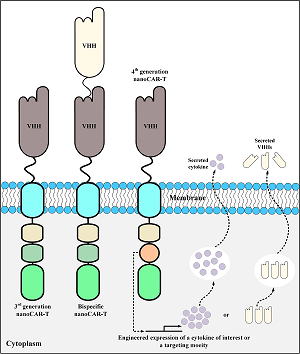
Relapsed/refractory T-cell malignancies (r/r T-ALL, T-NHL) carry a poor clinical prognosis, with limited benefit from conventional chemotherapy and hematopoietic stem cell transplantation, positioning cell therapy as a critical breakthrough direction. CD5 is highly expressed on the surface of most malignant T cells and represents a highly promising CAR-T target. However, conventional human CD5-CAR-T cells based on single-chain variable fragment (scFv) architectures suffer from insufficient expansion, limited cytotoxicity, and fratricide—technical bottlenecks that constrain clinical efficacy. Optimizing the extracellular antigen-recognition module of the CAR is therefore a key unmet challenge in CD5-targeted cell therapy.
Nanobodies—the variable domain of heavy-chain-only antibodies (VHH)—have a molecular weight of only approximately 15 kDa and offer a compact structure, high epitope-recognition diversity, and substantial flexibility for molecular engineering. They are increasingly being adopted to replace conventional scFv fragments as the extracellular recognition domain of CARs, providing a novel technical strategy for T-cell malignancy immunotherapy. A bispecific-epitope alpaca-derived anti-CD5 nanobody CAR-T (NbCD5 CAR-T) has been reported in clinical studies, and two first-in-human Phase I/II trials—NCT07070323 (r/r T-ALL) and NCT07022964 (r/r T-NHL)—are currently underway, validating the translational value of nanobody modules in cell therapy.
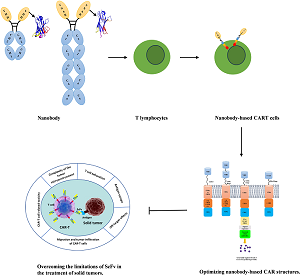
Preclinical data demonstrate that NbCD5 CAR-T cells exhibit superior in vitro cytotoxicity compared with conventional human scFv-based huCD5 CAR-T cells. In a Jurkat xenograft NSG mouse model, NbCD5 CAR-T cells achieved complete control of in vivo tumor burden, with significantly greater antitumor efficacy than the huCD5 CAR-T group. Its core advantage derives from the bispecific-epitope nanobody design: the smaller VHH scaffold facilitates efficient CAR expression on the T-cell membrane, improves the in vitro expansion capacity of CAR-T cells, and reduces cell loss attributable to fratricide.
Preliminary clinical data in humans have been disclosed. In the T-ALL cohort, all five subjects who received 1.0×10⁶/kg NbCD5 CAR-T cells achieved complete remission by day 30. Adverse events were manageable, predominantly grade 1 cytokine release syndrome (CRS), with only one case of grade 2 immune effector cell-associated neurotoxicity syndrome (ICANS); no high-grade severe toxicities were observed. These results confirm that nanobodies, serving as CAR recognition domains, not only enhance in vitro and in vivo antitumor activity but also offer an acceptable safety profile in humans.
Nevertheless, several challenges remain to be addressed: the risk of persistent T-cell lymphopenia due to CD5 expression on normal T cells; the risk of antigen-loss–mediated tumor relapse; and humanization of the bispecific-epitope nanobody sequences, together with optimization of large-scale viral vector and cell manufacturing processes. These are critical developability considerations that pharmaceutical companies and CROs must prioritize during R&D.
As the extracellular recognition domain of CAR-T cells evolves from conventional scFvs to nanobodies, VHH-centered cell-therapy engineering strategies are not limited to CD5 but can be extended to other T-cell malignancy targets such as CD7. For research institutions, nanobody library construction, specific VHH selection, multi-epitope molecular design, humanization, and functional validation are critical upstream steps in the development of such pipelines.
Nabody Life offers off-the-shelf anti-CD5 molecules that enable direct functional validation by customers. These ready-to-use anti-CD5 molecules are available across three tiers of antigen-binding capacity (high, medium, and low, as determined by flow cytometry), accommodating a range of affinity requirements. We also provide finished anti-CD5 recombinant antibodies carrying a C-terminal cysteine (Cys) tag, which can be directly conjugated to lipid nanoparticles (LNPs) for the validation of in vivo CAR functional activity.

Nanobody Full-Spectrum Customized Services byNBLST
NBLST is a nanobody industry platform initiated and established by Wuhan Industrial Innovation and Development Institute. It owns an independent laboratory covering 1,400 square meters at the Precision Medicine Industrial Base of Wuhan National Bioindustry Base. Meanwhile, it has set up an alpaca experimental base and a transit base compliant with laboratory animal standards in Zuoling, Wuhan and Tuanfeng, Huanggang respectively. At present, the bases house more than 200 alpacas in total, and can provide alpaca immunization services with "zero immune background" guarantee for research institutions and antibody drug R&D enterprises.
NBLST focuses on the research, development, engineering and application of nanobodies, and is committed to building an integrated industry-university-research public experimental service platform. The company has established a full-chain technology platform covering antigen preparation (polypeptides, proteins and RNA), antibody discovery and engineering modification, as well as biological function validation and screening. Among these, its RNA antigens include sequence- and structure-optimized RNA products suitable for alpaca immunization.Based on the proprietary NabLib® platform, the company employs the improved pDual bifunctional phage display technology. While retaining the high-efficiency development advantages of traditional phage display, this technology enables seamless connection with high-level expression in mammalian cells, significantly improving the efficiency of eliminating problematic molecules. Its NabLib® mammalian cell display technology not only enhances the developability of antibody molecules, but also allows flexible selection of screening formats, providing reliable support for downstream antibody applications and detection.Through the synergistic complementation of multiple platforms, the company provides flexible and efficient antibody discovery and engineering services for pharmaceutical companies and research institutions, supporting the development of innovative drugs and diagnostic reagents.
Contact Us:
Tel: 400-822-9180
Email: marketingdept@nanobodylife.com
References
[1] First-in-human novel bispecific epitope anti-CD5 nanobody CAR-T cells for refractory or relapsed T-cell malignancies[J]. JCO, 2026, 44(16_suppl): 7015.
[2] Hu XX, Pan J. Innovative structure empowerment: novel bispecific-epitope nanobody CD5 CAR-T for relapsed/refractory T-cell lymphoma[J]. Chinese Journal of Hematology, 2026.
[3] ClinicalTrials.gov. NCT07070323, NCT07022964. Nanobody CD5-CAR-T for Relapsed/Refractory T-cell Malignancies.
[4] Mamonkin M, et al. Targeting T cell malignancies using CAR-based immunotherapy: challenges and potential solutions[J]. Frontiers in Immunology, 2020.